



Listen...
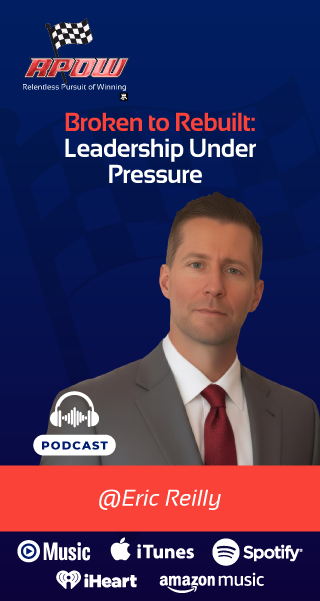
Broken to Rebuilt: Leadership Under Pressure
🔥 Excerpt
“Real leadership is not something people follow because they have to. It is something they choose to follow.”
⚡ TL;DR
When a career defining role disappears and a life changing injury alters the future, leadership becomes more than a professional skill. Eric Reilly’s journey reveals how leadership under pressure exposes the difference between authority and influence, resilience and control, and why character often matters most when certainty is gone.
📄 Show Notes
Organizations often celebrate strength, decisiveness, and control. Leaders are expected to absorb pressure, deliver results, and project stability regardless of circumstance. But the moments that define leadership emerge when control is lost.
Eric Reilly spent thirty years leading teams and driving performance across the healthcare and pharmaceutical industries. By his own estimate, the work he led generated over three billion dollars in revenue for one organization alone. Then two defining experiences stripped away much of what he had anchored his identity to. In 2015, he was struck head-on by a vehicle while cycling, sustaining fractures throughout his body, a lacerated bowel, a punctured lung, and severe muscle separation from his hip and back. Years of rehabilitation followed. And then, just last year, after running a national-level leadership meeting from start to finish, he received a phone call eight hours later informing him that his employment was over, effective immediately.
What emerged from both experiences was not simply a story of resilience. It became a deeper and more honest examination of what leadership actually requires when pressure removes certainty, identity, and routine.
The physical injury, as painful and prolonged as it was, opened something unexpected. Eric describes losing much of the confidence he had previously drawn from his athletic identity. With that gone, he found himself leaning harder into learning, into presence, into vulnerability. Team members began visiting him at home during recovery. He stopped being guarded about what he did not know or could not do. And the result was that the people he led opened up in ways they never had before. They shared struggles about their families, their health, their personal lives. They asked for guidance they had previously kept private. The distance that professional performance often creates had collapsed, and what replaced it was something more lasting: genuine human connection.
This is the tension Eric identifies at the center of leadership under pressure. When circumstances become difficult, many organizations tighten control. Leadership begins to look more like management. Trust gets replaced by oversight. Relationships become transactional. That approach may produce short-term compliance, but it rarely builds the kind of commitment that carries a team through sustained disruption.
Eric’s counterpoint is grounded in what he calls the five pillars of noble leadership: belief, wisdom, humanity, awareness, and the guardian role, which is his term for a leader’s genuine commitment to the people they serve. These are not competencies that can be delegated or automated. They require consciousness, character, and presence. His observation about artificial intelligence cuts to the heart of this: you can program a system to simulate responses, but you cannot program it to genuinely believe in something, to demonstrate true humanity, or to be authentically committed to another person’s development and wellbeing. Those remain distinctly human capacities, and they are the very qualities that make leadership real.
His experience on the receiving end of leadership failure made the contrast vivid. When a new organizational culture prioritized compliance over care and framed his legitimate accommodation needs as obstacles to productivity, the relationship collapsed. Not because the work stopped getting done, but because the human foundation had been hollowed out. That distinction between managing people and leading them is not abstract. It has direct consequences for trust, performance, and retention.
For leaders navigating teams through rapid technological change, Eric’s counsel is straightforward even if the execution is hard: tell the truth. Share what you know. Be honest about what you do not know. Acknowledge the uncertainty without abandoning the responsibility to provide direction. People can handle difficult information far better than they can handle being misled. What breaks trust is not bad news delivered honestly. It is the gap between what leaders say and what they do.
The relentless pursuit of winning, as Eric defines it, is not primarily about output. It is about staying connected to what matters most, and being honest with yourself about whether your time and energy are actually going toward those things. For founders, executives, and leaders facing conditions that are shifting faster than they can track, the fundamental challenge remains unchanged. Leadership is not tested when things are running smoothly. It is defined by how you show up when pressure challenges everything you assumed was stable.
✅ Key Takeaways
• Leadership and management diverge most clearly under pressure.
• People choose to follow leaders they trust, not just those in authority.
• Vulnerability can strengthen leadership credibility.
• Transparency builds stronger, more resilient cultures.
• Human connection becomes more valuable in high-pressure environments.
• Pressure exposes leadership gaps that success often hides.
• Leadership under pressure is grounded in character, not position.
👑 Host Info
Rick Meekins (https://rickmeekins.com/) is a serial entrepreneur, strategic business disruption advisor, podcast host, and speaker. As the host of The Relentless Pursuit of Winning Podcast, he explores what it truly takes to build, lead, and sustain meaningful businesses. With more than 30 years of experience working alongside founders and leadership teams, Rick focuses on developing disruptive strategies and elevating human insight in business.
Interested in working together, booking Rick, or partnering with the show?
Start here: https://rpowpodcast.com/contact/
🧭 Chapters
00:00 Introduction to Eric Reilly
02:30 The Left Turn: A Career Shift
06:18 The Traumatic Incident: A Life-Altering Experience
09:50 The Road to Recovery: Mindset and Gratitude
15:58 Leadership Through Vulnerability
24:05 Defining Leadership: The Human Element
28:31 Leading with Individuality
30:23 The Impact of AI on Leadership
33:45 Navigating Change and Honesty in Leadership
44:31 The Essence of Noble Leadership
50:25 Maintaining the Relentless Pursuit of Winning

Biography
Eric Reilly lives in the Lake George area of Upstate NY with his wife, three children, and an ever changing managerie of animals. An avid outdoorsman and athlete, Eric embraces adventure and loves overcoming unexpected obstacles.
After spending 30 years leading teams and developing future leaders for one of the largest privately held companies in the world, Eric recently founded the Noble Leadership Initiative to help others discover their innate leadership capabilities.
Relying on the wisdom gained through his experiences, Eric hopes to change the narrative about leadership, helping people learn a new way of relating to each other. When not writing or working on the Noble Leadership Initiative, Eric can be found enjoying the Adirondack lakes and mountains with his family.
Other Information
Other episodes...