





Listen...
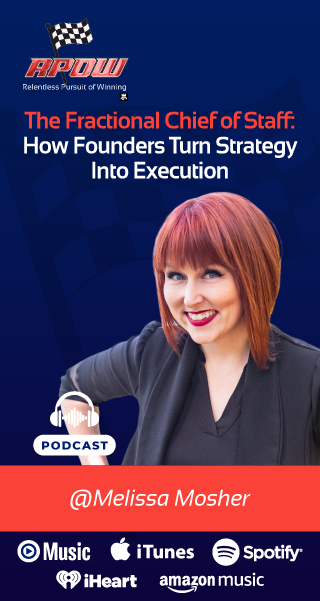
The Fractional Chief of Staff: How Founders Turn Strategy Into Execution
🔥 Excerpt
“Be relentless in your pursuit and flexible in your approach.”
⚡ TL;DR
A strategy can be sound and still fail to move because nobody owns the work required to execute it. Melissa Mosher explains how a fractional chief of staff gives founders strategic project leadership, helps prioritize competing initiatives, coordinates across business functions, and keeps important ideas moving without overwhelming the founder or disrupting the core business.
📄 Show Notes
Founders rarely run out of ideas. The harder problem is deciding which ideas deserve attention, who will carry them forward, and how to make progress without allowing every new initiative to disrupt the business already generating revenue.
That is where a fractional chief of staff can become valuable.
Melissa Mosher runs Get Goalz, an operations intelligence agency focused on fractional chief of staff programs, strategic initiatives, founder operations, and project execution. With 18 years of corporate experience, she brings a perspective centered on turning complex ideas into work that can actually move.
The role is not simply operational support. Melissa describes the chief of staff as the person who takes ownership of a strategic initiative and moves across functions to make sure the work gets done. Marketing may need to be involved. Sales may need to be involved. Operations may need to be involved. The founder should not have to personally coordinate every connection.
This becomes especially relevant when a founder has a strong vision but limited capacity. A business might be doing well while the owner is simultaneously considering a new product, building an app, expanding an offer, entering a new market, or transforming an existing service. The new idea does not eliminate the responsibilities of the existing business.
Melissa’s approach begins with prioritization. If everything is treated as urgent, meaningful progress becomes difficult. A fractional chief of staff helps assess the available people, resources, time, and business priorities before deciding what should happen next. Sometimes the right answer is to move forward immediately. Sometimes it is to slow down, validate an idea, or establish a milestone before committing more resources.
That judgment is particularly important because founders are often emotionally connected to their ideas. Melissa describes her role as someone willing to challenge the path without undermining the person behind the idea. The founder remains responsible for the destination. The chief of staff helps create a workable path toward it.
The distinction between consulting and execution is another important part of the conversation. A consultant may provide analysis, recommendations, and a plan. A fractional chief of staff stays close to the implementation, considering the capacity of the founder and team and helping translate the recommendation into coordinated action.
Melissa describes her process as decode, design, and do. First, understand what is actually happening. Then determine the plan or immediate milestone. Then execute, learn, and adjust. The purpose is to prevent a company from becoming trapped in endless planning and design.
The approach also recognizes that not every initiative needs permanent support. Melissa may help validate and launch an initiative, enable the execution, and then step back when the appropriate team or department can own it. Her role can return when the founder is ready to build, grow, or transform something new.
For founders carrying too many priorities, the value is ultimately clarity and capacity. Vision remains with the founder, while execution gains a dedicated owner who can coordinate the moving parts and keep progress connected to the broader business.
A fractional chief of staff is therefore not simply another person added to the organizational chart. The role exists to give important initiatives a driver, protect founder capacity, and turn strategic intent into sustained movement.
The goal is progress without losing sight of the business that made the opportunity possible.
✅ Key Takeaways
- Strategy needs clear ownership to become execution.
- Founders need space to protect vision and make important decisions.
- Prioritization becomes essential when multiple initiatives compete for limited capacity.
- A chief of staff coordinates cross functional work without requiring the founder to manage every connection.
- Good execution includes validation, planning, action, learning, and adjustment.
- Challenging an idea can strengthen the path without diminishing the founder behind it.
- Fractional support can flex around an initiative and step back when the organization is ready to own it.
👑 Host Info
Rick Meekins (https://rickmeekins.com) is a serial entrepreneur, strategic business disruption advisor, podcast guest, and host of The Relentless Pursuit of Winning Podcast, where he explores what it actually takes to build, lead, and sustain meaningful businesses. With over 30 years of experience working alongside founders and leadership teams, Rick focuses on helping companies develop and implement disruptive advantages and developing platforms to explore and distribute human insight.
Interested in working together, having Rick speak, or partnering with the show?
Start here: https://rpowpodcast.com/contact/
🧭 Chapters
00:54 Welcome and introduction
01:39 Melissa’s background and Get Goalz
02:50 What a chief of staff is and is not
04:32 Why entrepreneurs need strategic project leadership
06:12 Prioritizing ideas and protecting capacity
08:02 Fractional chief of staff vs. consultant
09:54 A real-world app-building example
12:17 Building the MVP and testing assumptions
14:55 Challenging founders without crushing the vision
18:11 Helping founders recover from bad ideas or bad execution paths
20:20 Preserving the founder’s vision
24:10 What makes a fractional chief of staff effective
26:55 Melissa’s three core strengths
31:22 The Decode–Design–Do framework
33:11 The Validate–Enable–Own framework
35:12 Using AI for cognitive synthesis
36:26 Analyzing networking conversations with AI
38:56 Three ways to work with Get Goalz
40:49 Maintaining the relentless pursuit
43:32 How to connect with Melissa
#fractionalchiefofstaff #founderoperations #strategicexecution #businessstrategy #leadership #entrepreneurship #projectmanagement #rpowpodcast #relentlesspursuitofwinning

Biography
Your strategic initiative shouldn’t be someone’s second job. Give it an owner, get it moving, and make progress inevitable.
Melissa Mosher is the founder of Get Goalz, an Ops Intelligence Agency helping founders lead the strategic initiatives that move their businesses forward.
Melissa specializes in the messy middle between “we’re doing this” and “it actually happened.” When an initiative spans the business, someone has to own the invisible work—aligning people, decisions, dependencies, priorities, and momentum. That’s where she comes in.
As a Fractional Chief of Staff, Melissa sits alongside founders and CEOs to lead the work that’s too important to delegate, too cross-functional for one department, and too complex to manage alongside everyone’s day job.
Her work sits at the intersection of strategy, execution, and executive capacity—turning ambitious ideas and important decisions into initiatives the business can actually deliver.
The goal isn’t more strategy. It’s making progress inevitable.
Other Information

Other episodes...