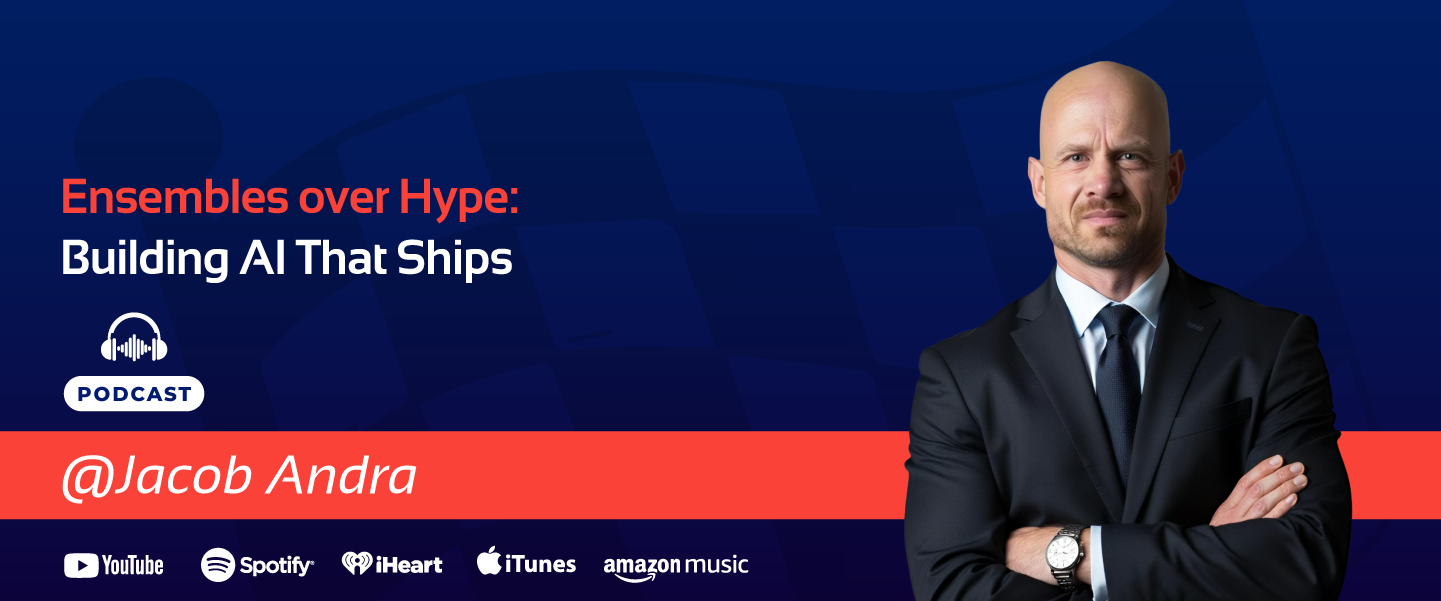
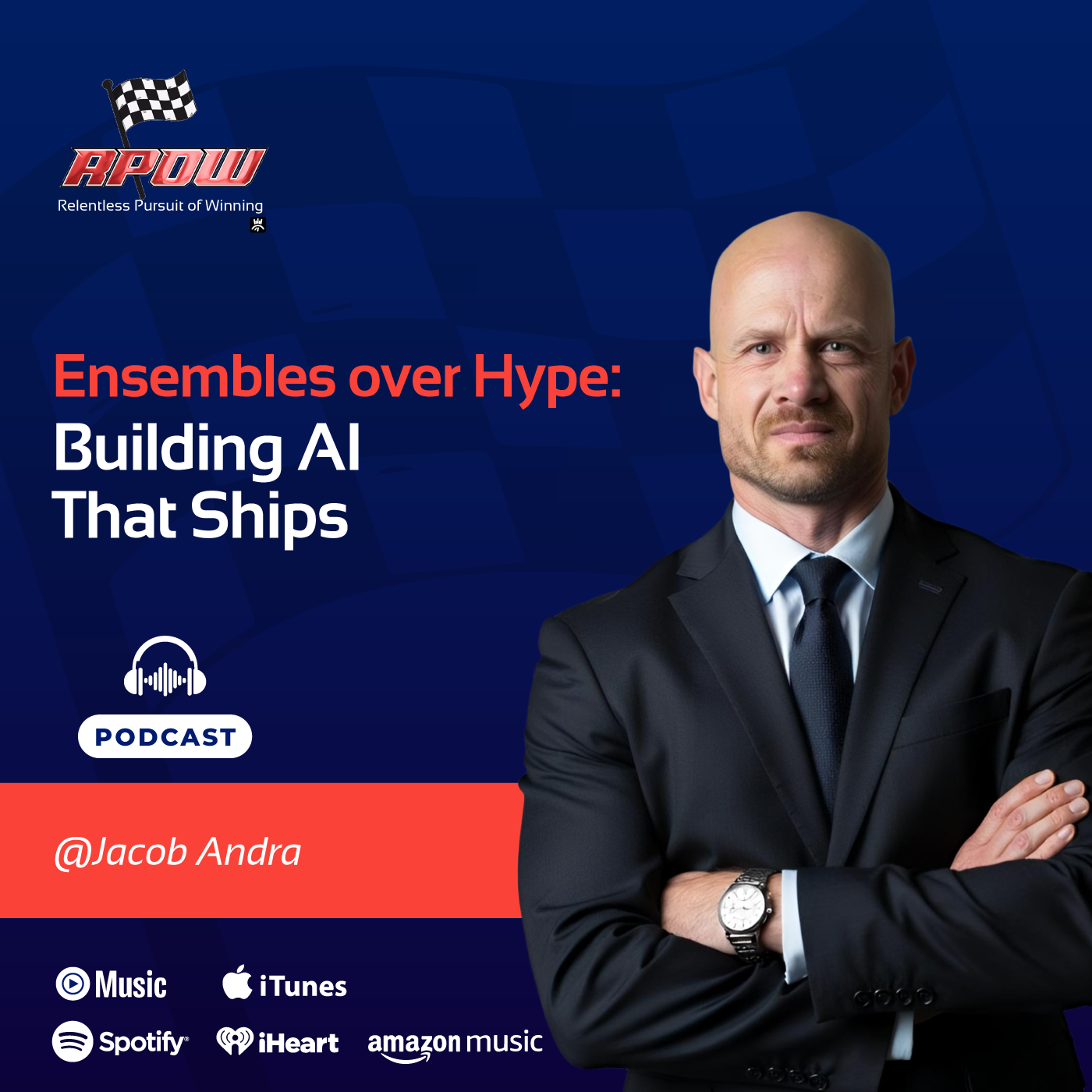
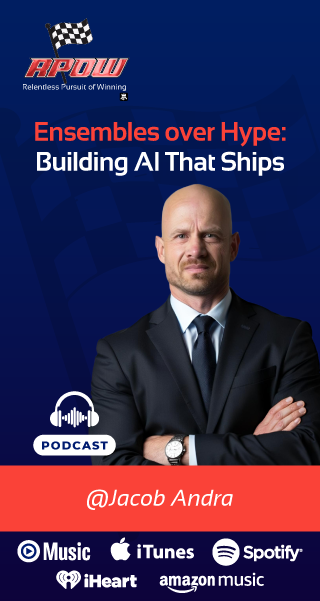
Ensembles Over Hype: Build AI That Ships | Jacob Andra
🔥 Excerpt
“A tool is not a capability. A standalone tool is not integrated with your core data sources — there’s a lot that goes into creating a capability that goes way beyond the adoption of a specific tool.” — Jacob Andra
⚡ TL;DR
Building AI that ships requires moving beyond tools and into integrated systems. Jacob Andra explains how organizations create real value by aligning AI capabilities with business processes, data, and decision-making — rather than checking the box with a ChatGPT or Copilot subscription.
📄 Show Notes
Building AI that ships starts with clarity. In this conversation, I sat down with Jacob Andra — CEO and co-founder of Talbot West — to unpack what most leaders are getting wrong about AI and what it actually takes to make it work inside a business.
Building AI that ships is not about subscribing to tools. It is about understanding your organization as a system. Jacob walked through how most companies mistake access for capability. A license does not create advantage. Integration does. He describes it through the “onion model”: the outer layers represent easy individual workflow wins — like using a custom GPT to compress three days of RFP intake work into minutes — while the deeper layers involve systems engineering, connected data, and real organizational intelligence.
What stood out was the distinction between surface-level efficiency and deeper organizational intelligence. Those outer-layer gains will become table stakes quickly. As Jacob put it, competitive advantage will come from doing the actual systems engineering work — integrating core data sources, connecting workflows, and enabling systems to communicate with one another.
We also explored the gap between expectation and reality. AI accelerates thinking, but does not replace it. Jacob’s advice: treat these tools like a cognitive exoskeleton, not a replacement for judgment. Follow the chain of thought, verify outputs, and never delegate responsibility for accuracy. Leaders still carry responsibility for validation and direction.
The conversation went deeper into custom language model implementations — including a real-world example of a field services firm that pointed a model at thousands of technical manuals, dramatically cutting research time for technicians in the field. We also discussed Talbot West’s new partnership with Lucidity Sciences and their LumaWarp model, which outperformed competing machine learning models on industry benchmarks for predictive data analysis — with applicability in financial forecasting, medical diagnosis, and more.
Jacob also covered practical security considerations: the difference between consumer-tier cloud tools and private instances, the option to run models locally with no internet connection for high-security environments, and open source LLMs like Ollama and Qwen for those with more technical appetite.
Building AI that ships ultimately becomes a leadership challenge. The North Star, as Jacob describes it, is a company that functions like the onboard computer of a sci-fi spaceship — integrated, systems-aware, and intelligent at its core. Getting there requires clarity of purpose, disciplined execution, and a willingness to rethink how work flows across the entire organization. This is not about chasing what is new. It is about building what works.
✅ Key Takeaways
• AI tools do not equal AI capability
• Start with business problems, not technology
• Early gains come from individual workflows, not full transformation
• Competitive advantage comes from system integration
• Human judgment remains essential in every AI-driven process
• Organizational intelligence is the long-term objective
• Security options range from cloud-based opt-outs to fully local, air-gapped deployments
• Open source LLMs (Ollama, Qwen) are viable options for more technical teams
Website: talbotwest.com
Email: jacob@talbotwest.com
👑 Host Info
Rick Meekins (https://rpowpodcast.com) is a serial entrepreneur, strategic business disruption advisor, podcast guest, and host of The Relentless Pursuit of Winning Podcast, where he explores what it actually takes to build, lead, and sustain meaningful businesses. With over 30 years of experience working alongside founders and leadership teams, Rick focuses on helping companies develop and implement disruptive advantages and developing platforms to explore and distribute human insight.
Interested in working together, having Rick speak, or partnering with the show?
Start here: https://rpowpodcast.com/contact/
🧭 Chapters
00:00 Introduction and context
02:30 Jacob’s background and entry into AI
06:00 The problem with tool-driven thinking
10:30 The onion model of AI adoption
13:30 Expectation versus reality with AI tools
21:00 Custom models and real-world use cases
27:00 Data, systems, and deeper integration (LumaWarp / Lucidity Sciences)
33:00 AI and the future of work
38:00 Security and open source options
42:00 Organizational intelligence as the goal