






Listen...
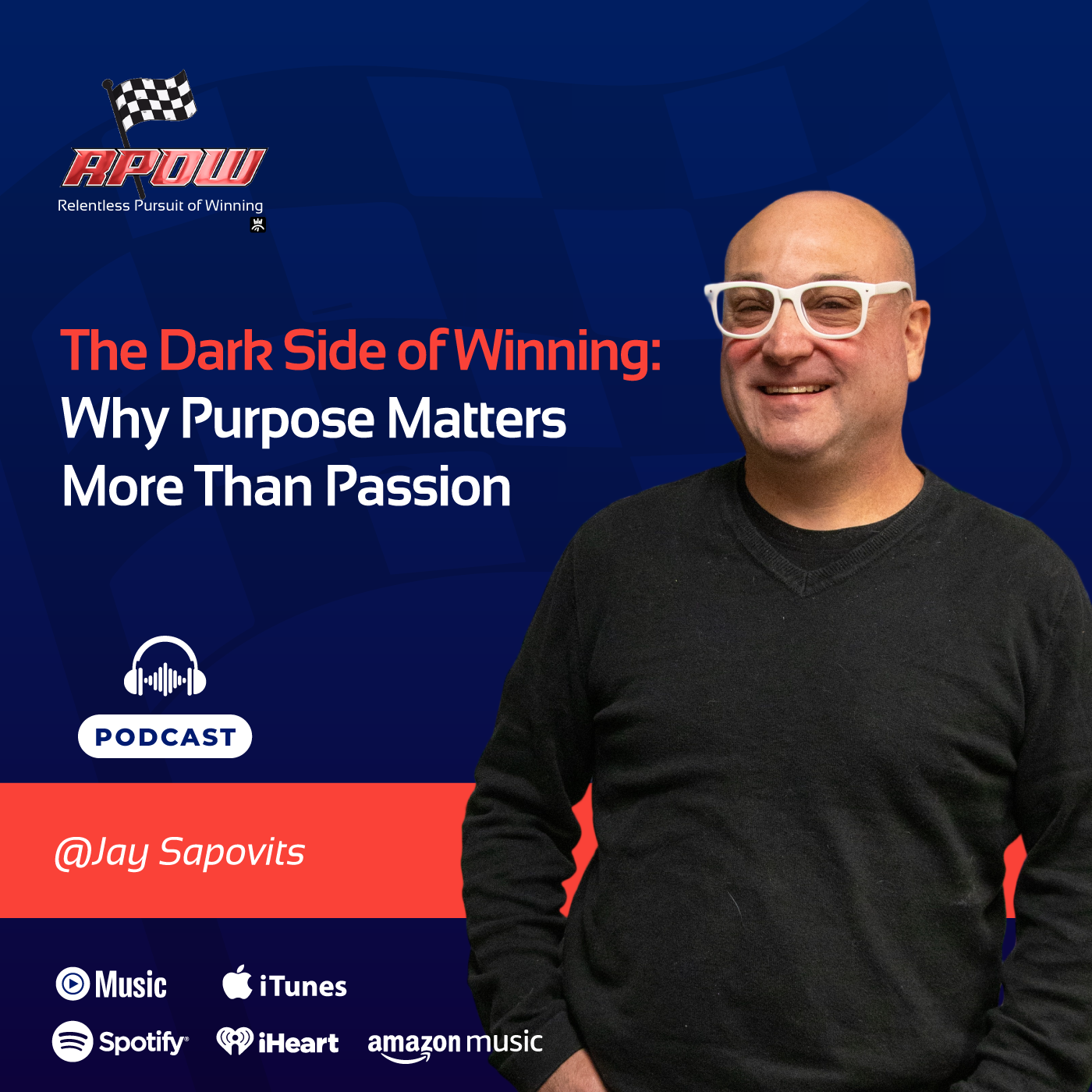
The Dark Side of Winning: Why Purpose Matters More Than Passion
🔥 Excerpt
“You don’t work for money. You work for purpose, and the money comes.”
⚡ TL;DR
Jay Sapovits shares the hard-earned lessons behind a life of entrepreneurship, from recovery and early business experiments to helping scale a company from zero to more than a billion dollars in under five years. He explains why purpose is more durable than passion, why entrepreneurship is fundamentally about solving problems, and how resilience, honest self-assessment, relationships, and culture shape sustainable success.
📄 Show Notes
Winning is often presented as the goal of entrepreneurship. But what happens when winning becomes the only goal?
Jay Sapovits offers a more complicated and honest view of entrepreneurial success. His journey includes major accomplishments, serious setbacks, recovery from compulsive gambling, multiple businesses, high-growth environments, and the ongoing challenge of building a meaningful life while pursuing ambitious goals.
Jay describes himself as a lifelong doer. Early in his career, he followed a “ready, fire, aim” approach – moving quickly, taking action, and figuring things out along the way. With age and experience, he learned the value of slowing down enough to aim before firing.
His entrepreneurial journey began after leaving a career in sports radio and entering recovery from compulsive gambling. He took a recovery job at a golf club, where he noticed patterns in customer traffic and identified opportunities the existing business was not addressing.
Jay’s experience illustrates his view of entrepreneurship: it begins with solving a problem, not simply inventing a business idea.
His framework is straightforward:
1. Identify a problem.
2. Develop a potential solution.
3. Determine whether other people have the same problem.
4. Confirm that enough people have it.
5. Find out whether a stranger will pay for the solution.
A solution without a market is not a business.
The conversation then turns to Jay’s experience with Marquis Jet. He joined the company when it had no revenue and helped open the Boston office before eventually running the Midwest region. The company grew from zero to more than a billion dollars in revenue in approximately four and a half years.
That experience exposed Jay to a much larger scale of business and introduced him to leaders who had achieved extraordinary financial success. One conversation changed how Jay thought about work and motivation.
A client explained that he continued working because he was good at business and not good at golf. Jay realized that money was not always the primary driver for high-performing entrepreneurs. Purpose, mastery, responsibility, contribution, and the satisfaction of doing meaningful work can be more powerful than financial rewards.
Jay argues that purpose is more durable than passion. Passion can fade when the work becomes difficult, repetitive, or financially stressful. Purpose provides a deeper reason to continue.
He also warns against confusing personal passion with a viable business. People frequently invest in businesses built around hobbies or interests without proving that enough customers exist. Jay uses fitness studios, golf businesses, restaurants, and other passion-driven ventures as examples of how entrepreneurs can fall in love with an idea before validating demand.
His advice is practical: find customers before investing heavily in infrastructure. Nothing happens until something is sold.
Jay also reflects on the importance of understanding the difference between enjoying an activity and owning a company built around that activity. Someone who loves cooking may be happier as a chef than as the owner of a restaurant. Someone who loves golf may not want the financial and operational burden of owning a golf facility.
After working in private aviation and luxury villa rentals, Jay founded Ink’d Stores. The company began as a fitness-equipment manufacturing business that decorated equipment with corporate logos. When sales velocity did not meet expectations, Jay and his team pivoted.
They realized they already knew how to decorate difficult materials and decided to apply that capability to products people already wanted to buy. That pivot led to Ink’d Stores, an on-demand swag and merchandise company serving organizations with decorated apparel, promotional products, and branded merchandise.
Jay describes the company’s core idea as decorating anything with everything — helping organizations bring their identity to life through merchandise and branded products.
The conversation also covers leadership maturity. Jay explains that he has moved from hiring quickly and tolerating poor fits to hiring more carefully and acting faster when a person is not working out.
He learned that the perfect candidate is not going to walk through the door and instantly solve every business problem. At the same time, he recognizes that trust can be emotionally difficult, especially when a leader carries the responsibility for the company’s results.
His philosophy is that employees should not have to absorb unnecessary pressure from the owner. The business already contains enough natural pressure. Jay tries to carry the weight while allowing team members to do their best work.
He shares an example of hearing employees laugh and socialize at the beginning of the workday. Instead of interrupting them and demanding immediate productivity, he recognizes that people who enjoy one another’s company may ultimately collaborate better and perform at a higher level.
For Jay, a healthy workplace is not one where people never have fun. It is one where people take the work seriously without taking themselves too seriously.
The episode closes with a challenging perspective on relentless pursuit. Jay believes that some people possess an innate drive to keep moving, while others may not be suited to entrepreneurship — just as some people are not suited to traditional employment.
His advice is not meant to discourage people. It is an invitation to practice radical self-awareness. Entrepreneurs need to understand their strengths, weaknesses, resilience, motivations, and likely responses when circumstances become difficult.
The dark side of winning is pursuing success without knowing why. Purpose gives ambition direction. It helps entrepreneurs continue through setbacks without allowing money, status, or momentum to become the only measure of a meaningful life.
✅ Key Takeaways
- Passion can initiate action, while purpose can provide lasting direction.
- Solve a real problem and establish whether a viable market exists.
- Validate demand before committing heavily to infrastructure.
- Experience can turn rapid action into more deliberate decision making.
- Purpose can connect business performance with responsibility and contribution.
- Strong leaders give capable people direction, trust, and room to perform.
- Culture can support performance when people feel respected and connected.
- Self knowledge is essential when deciding whether entrepreneurship fits.
👑 Host Info
Rick Meekins is a serial entrepreneur, strategic business disruption advisor, podcast guest, and host of The Relentless Pursuit of Winning Podcast, where he explores what it takes to build, lead, and sustain meaningful businesses.
With more than 30 years of experience working alongside founders and leadership teams, Rick focuses on helping companies develop and implement disruptive advantages and creating platforms to explore and distribute human insight.
Interested in working together, having Rick speak, or partnering with the show?
Start here: rpowpodcast.com/contact
🧭 Chapters
00:00 The evolution of entrepreneurial drive
01:37 From ready fire aim to thoughtful action
03:07 Recovery and rebuilding
05:07 Finding opportunity in operational gaps
08:11 Entrepreneurship as problem solving
09:57 Purpose Over Passion
16:05 Lessons from the golf business
19:30 Scaling Marquis Jet
22:25 Purpose and meaningful work
26:20 Learning through business failure
27:43 Choosing family and presence
28:32 Reinventing Ink’d Stores
29:55 The evolution of decision making
33:03 Leadership through trust
35:43 Building a healthy culture
41:17 The nature of relentless pursuit
44:07 Self-knowledge and entrepreneurial fit
#entrepreneurship #purpose #passion #businesssuccess #resilience #leadership #companyculture #rpowpodcast #relentlesspursuitofwinning

Biography
Jay Sapovits, a lifelong entrepreneur and the Founder and President of Ink’d Stores, an on-demand swag and merchandise company serving thousands of organizations. Jay has helped scale a company from zero to over a billion dollars in under five years, navigated major business setbacks, and built Ink’d to nearly $5 million in annual recurring revenue through persistence, smart pivots, and a relentless focus on relationships and sales. His journey is a real-world look at what entrepreneurship actually demands—and how resilience often matters more than hype or technology.
Other Information

Other episodes...