



Listen...
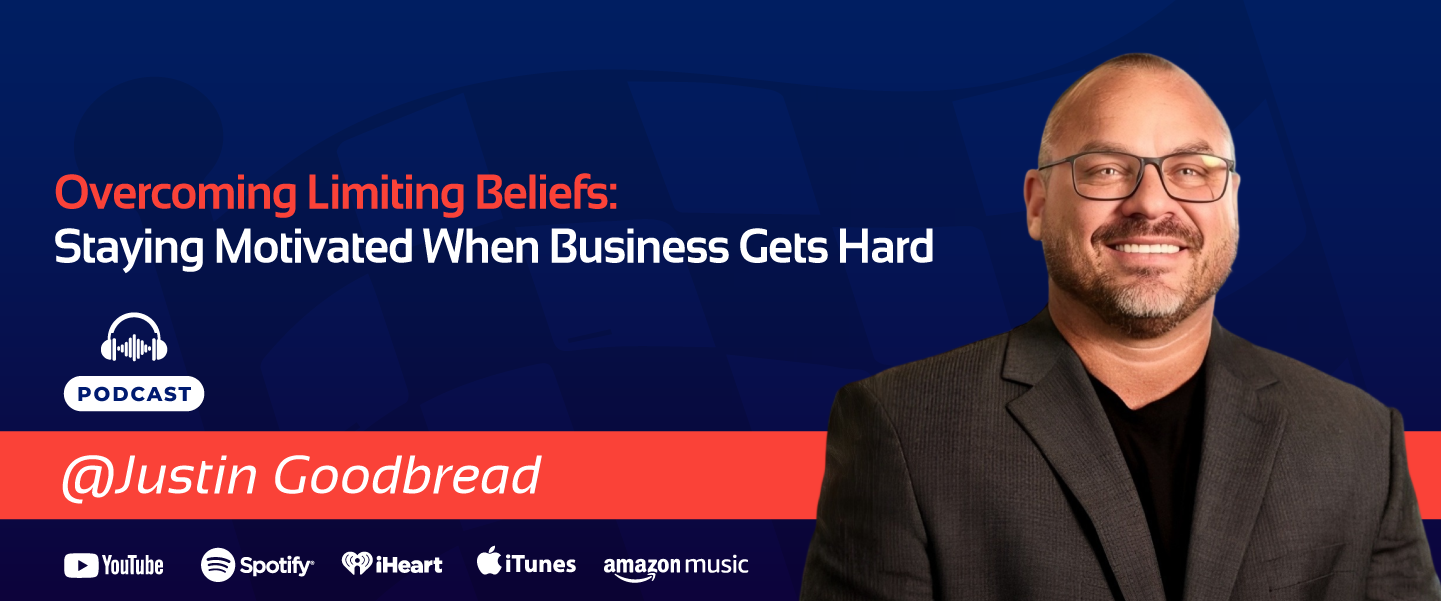
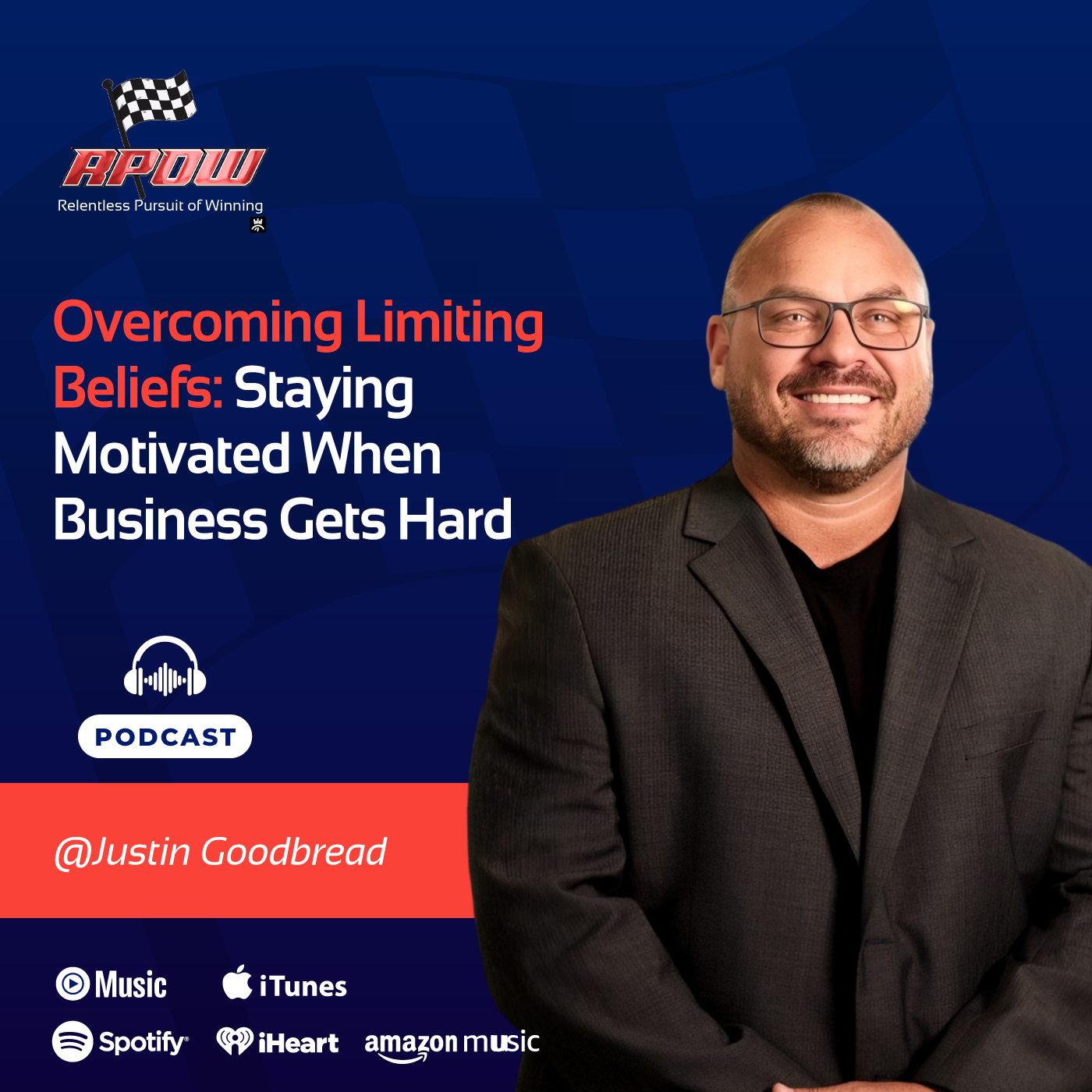
Overcoming Limiting Beliefs: Staying Motivated When Business Gets Hard
🔥 Excerpt
“Your purpose cannot be stolen, but your focus can be diluted.”
⚡ TL;DR
Business becomes difficult long before the numbers necessarily reflect it. Justin Goodbread explains how pride, uncertainty, comfort, burnout, and unclear purpose can quietly become limiting beliefs that keep entrepreneurs from moving forward. The conversation centers on developing clarity, examining what is holding you back, staying focused on the outcome you truly want, and recognizing that difficult seasons can require a change in how you lead rather than simply more effort.
📄 Show Notes
There is a point in almost every business where working harder stops solving the problem.
You are still showing up. The business is still operating. Revenue may even be growing. But the energy is different.
The excitement that once made every early morning worthwhile has started to disappear.
You begin asking questions that are difficult to admit.
Why does this feel so hard? Why am I not making progress? Have I lost my motivation? Is the business actually the problem, or am I?
For entrepreneurs, these questions often point toward something deeper than strategy.
Overcoming limiting beliefs begins with recognizing the beliefs that quietly shape our decisions.
Justin Goodbread speaks candidly about his own experience with pride and self-reliance. Capable entrepreneurs are often accustomed to solving problems themselves. That strength can become a limitation when the belief that “I can do this myself” prevents them from accepting help, seeking coaching, or recognizing what they cannot see on their own.
The same pattern appears in different forms for different business owners. One person may struggle with pride.
Another may lack confidence in the outcome. Someone else may have lost clarity about what they actually want. These beliefs do not always announce themselves. Sometimes they appear as procrastination, overwork, indecision, or simply losing the fire that used to drive the business.
Then there is comfort.
Success can create its own form of resistance. Once a business begins producing reliable income and providing a comfortable lifestyle, the willingness to take meaningful risks can diminish. Justin describes this as the “sand castle effect.” We build something valuable, the waves begin approaching, and instead of continuing to build, we spend our energy protecting what we already have.
Overcoming limiting beliefs therefore requires more than positive thinking. It requires honest examination.
What are you protecting?
What are you afraid to lose?
What are you unwilling to delegate?
What goal would still matter enough to pursue if success were not guaranteed?
Justin’s own story illustrates the relationship between clarity and persistence. At 16, he became fixated on owning a 1964 Shelby Cobra. Decades later, that vision became reality. His larger point is that sustained attention toward a clearly defined outcome influences the decisions and behaviors that eventually move us toward it.
Business works the same way.
If the only objective is “make more money,” it becomes difficult to know what enough looks like. But when the desired outcome connects to freedom, family, contribution, impact, or a specific vision for life, the daily work acquires greater meaning.
Entrepreneurs can spend years building something before the results become visible. Justin emphasizes that business owners often become discouraged because they plant something and expect to see the harvest immediately. The reality is that different investments produce results in different seasons.
Sometimes the answer is not to abandon the goal.
Sometimes the answer is to understand the season you are in.
Continuing to operate as though the business still depends entirely on the founder can create exhaustion and make motivation harder to sustain.
This is where overcoming limiting beliefs becomes an operational issue as much as a personal one.
The belief that nobody can do it as well as you can may keep you at the center of every decision. The belief that asking for help signals weakness can prevent you from finding the right coach or advisor. The belief that slowing down means losing momentum can keep you from doing the introspective work necessary to determine what should happen next.
Ultimately, staying motivated through difficult seasons is not about feeling energized every day.
It is about knowing what matters, examining what is getting in the way, and continuing to make decisions that move you toward the life and business you actually want.
Overcoming limiting beliefs requires the willingness to look inward when the instinct is to work harder outwardly.
Sometimes the next breakthrough does not begin with another strategy.
It begins with an honest answer to a harder question:
What is the belief that is keeping me from moving forward?
✅ Key Takeaways
- Limiting beliefs can appear as pride, uncertainty, fear, comfort, or lack of clarity.
- Motivation becomes harder to sustain when the desired outcome is unclear.
- Difficult seasons require introspection as well as persistence.
- Growth changes what a founder needs to do personally within the business.
- Delegation can become necessary when carrying everything yourself creates burnout.
- Coaching provides accountability, perspective, and access to experience.
- Progress often happens in a different season from when the work begins.
- Clear purpose makes it easier to remain committed when business becomes difficult.
👑 Host Info
Rick Meekins ( https://rickmeekins.com) is a serial entrepreneur, strategic business disruption advisor, podcast guest, and host of The Relentless Pursuit of Winning Podcast, where he explores what it actually takes to build, lead, and sustain meaningful businesses. With over 30 years of experience working alongside founders and leadership teams, Rick focuses on helping companies develop and implement disruptive advantages and developing platforms to explore and distribute human insight.
Interested in working together, having Rick speak, or partnering with the show?
Start here: https://rpowpodcast.com/contact/
🧭 Chapters
00:51 Welcome and introduction
02:48 Hard seasons, purpose, and finding clarity
09:40 Identifying limiting beliefs
12:26 Comfort, risk, and the sand castle effect
13:48 The 1-3-1-3 business growth framework
17:27 Why coaching and accountability matter
21:23 Recovering from major disruption
25:42 The Decamillionaire Way
28:29 Building freedom beyond money
31:19 Habits that support success
34:15 Faith, authenticity, and business
38:20 Maintaining the relentless pursuit
41:02 The importance of introspective work
#limitingbeliefs #entrepreneurship #businessmindset #leadership #businessgrowth #motivation #personaldevelopment #rpowpodcast #relentlesspursuitofwinning

Biography
International Speaker | #1 WSJ Best-Selling Author | 7x Business
Exits | Global Expert on Business Growth & Exit Strategy
Justin Goodbread is a proven, in-demand speaker trusted by national organizations, business networks, and executive communities around the world. A DecaMillionaire by age 40, Justin has built, scaled, and exited seven companies—including 7-, 8-, and 9-figure firms—and coached hundreds of business owners to double or triple their company’s value, generating hundreds of millions in enterprise growth. He’s the #1 Wall Street Journal bestselling author of Your Baby’s Ugly (#56 on USA Today), and The Ultimate Sale, an international bestseller hailed as essential reading for entrepreneurs. He’s also the founder of The DecaMillionaire Way and host of DecaMillionaire Decoded, a Top 1% globally ranked business podcast.
Justin’s insights have been featured in over 300 outlets including Forbes, The Wall Street
Journal, Kiplinger, Yahoo! Finance, and USA Today. He’s a 5x Investopedia Top 100 Most
Influential Advisor, Exit Planner of the Year, and a member of the Exit Planning Circle of
Excellence. But what makes Justin a true audience favorite is his ability to pair boardroom
strategy with back-porch clarity. With a blend of Southern grit, straight talk, and humor, he
connects deeply with successful-yet-overwhelmed business owners—delivering actionable takeaways, mindset shifts, and a roadmap to build a company that grows without them.
Other Information
Other episodes...